
She Wasn't Wrong
The point where I stopped fitting and started making.

I was sitting at the table in the studio, a laptop in front of me and counting down the seconds. I had a Zoom call scheduled with a gallerist for a portfolio review. I’d logged on five minutes early to leave a good impression, and now it was time.
The room I was logged into remained empty. I started clicking around nervously, looking for a link. I was late.
Then she sent me an email.
“Hi Robert, I’m online and ready. Don’t see you in the waiting room. Here’s the link again, in case there’s a tech issue.”
Thank God. Click, and I was in.
I did say sorry, but the welcome was warm, and we actually struck up a conversation about something entirely unrelated to what was at hand until we noticed.
Twenty images lined up in a folder, ready to show. We moved through them one by one.
She was precise. Direct. Not dismissive, not overly enthusiastic. Very attentive. She asked good questions. I think I talked too much.
She spoke about cohesion, about how the work holds together when seen as a group. And she said “You shouldn’t introduce your work to people as single images.” Then suggested I pair them up or sequence them.
When we reached the last few images, I showed her two images I had hesitated to include. I guess I stuck them in because they were the most recent. And new stuff always feels relevant.
There was a shift. She leaned in slightly.
“These are something else,” she said.
“These don’t belong with the rest.”
She wasn’t wrong.
That was the problem.
It bothered me because the pieces didn’t fit into how I’d been marketing the work. I must say, the dumbest advice I’ve taken from the current zeitgeist is to niche down. And yes, selling an elevator pitch is easier, but for me retrospectively, it’s caged me in.
It was not different to me because it came out of and is part of my artistic process. Just a little too far out of the spectrum of what I’d shown until now.
It made me feel like I needed to rethink how to represent my work, and part of my work is to always be working. One image will lead to an idea for another, and so on.
Until now, I’d shown the end product, never the actual work.
Does that make sense?
I felt like I’d never shown anything before.
In high school I’d taken journalism, worked for the school paper, and even had a crew of rogue classmates, and we put out a little pirate newspaper filled with stuff we couldn’t place in the official school paper.
Along with my love for print magazines, from skate mags to cultural mags like Details, to the photography books I love and buy too many of.
But I didn’t want it to be a photo zine. I wanted to include copy. I feel copy is important, and making images that hang on the wall, or making images in the reader’s brain, is somehow the exact same thing.
And that’s how the idea developed and marinated for the greater part of 2025. I’d been given some time and a good excuse to be less productive and performative with my art.
I went on parental leave and quietly worked on what I wanted the magazine to be.
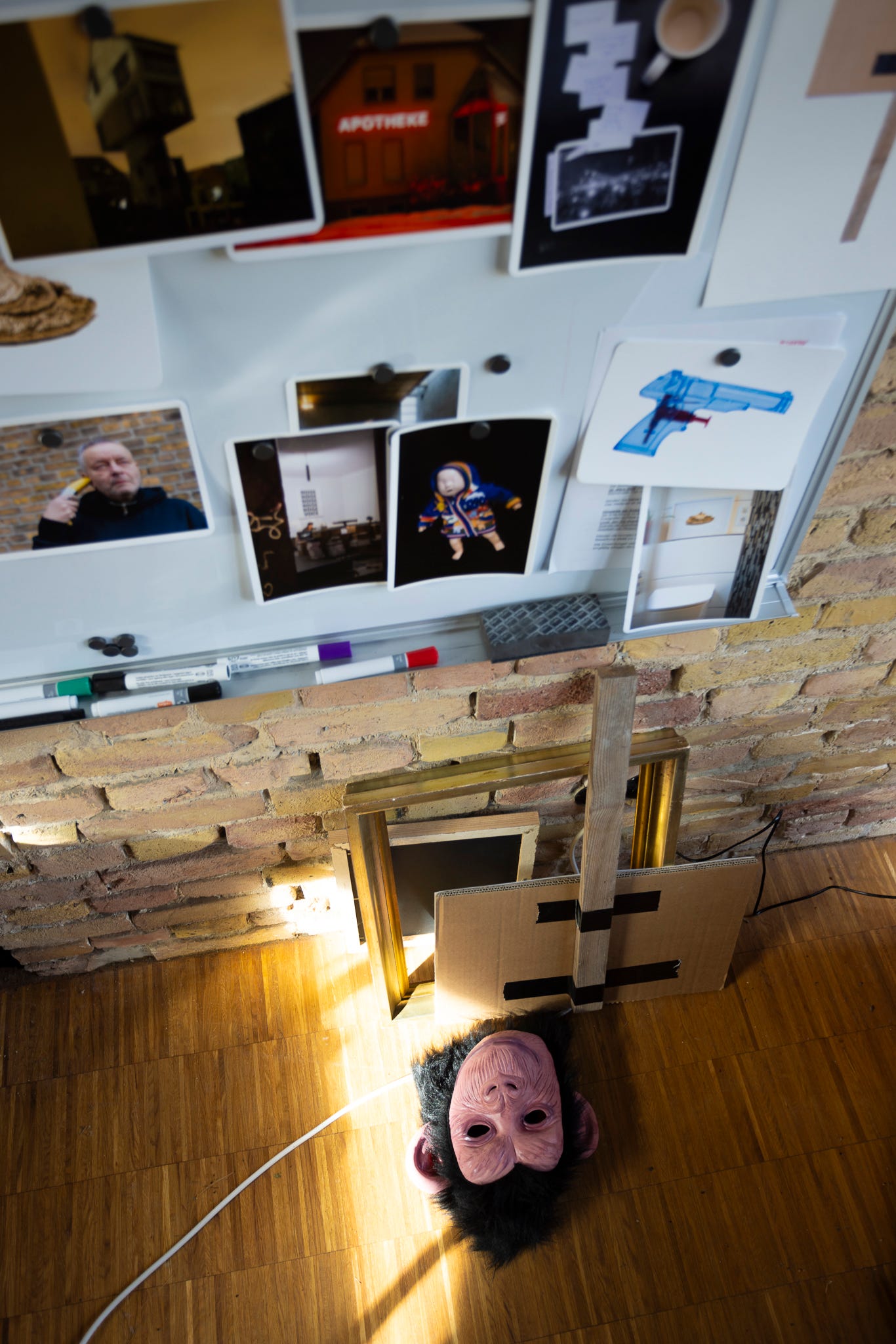
It stopped being an idea when I bought and hung a whiteboard in the studio and started working on the layout physically.
It really stopped being an idea when it showed up on the doorstep.
I still have a portfolio. I don’t even think it’s better than the one I showed the gallerist.
What has happened, more than redefining the niche, is that the magazine is now the canvas. Each issue ends up a relic and a time document.
I called it Team People.